
Braun and Clarke’s thematic analysis and Saldana’s are arguably among the most comprehensively delineated approaches or frameworks for qualitative data analysis. Braun and Clarke proposed a six-phase process, which our qualitative researchers are well versed in and apply in analyzing your interviews, focus groups, observations, or archival data. It is essential to understand that while Braun and Clarke’s thematic analysis is outlined in a logical sequential order, the analysis process is not linear, but iterative and recursive, a concept that our qualitative data analysts understand effectively. The thematic data analysis process is time-consuming, which is one of the main reasons you should leverage the expertise of our qualitative data analysts, who already understand Braun and Clarke’s thematic analysis 6 steps.
Braun and Clarke Thematic Analysis: Six-Phase Process
- Phase One: Familiarizing with the data
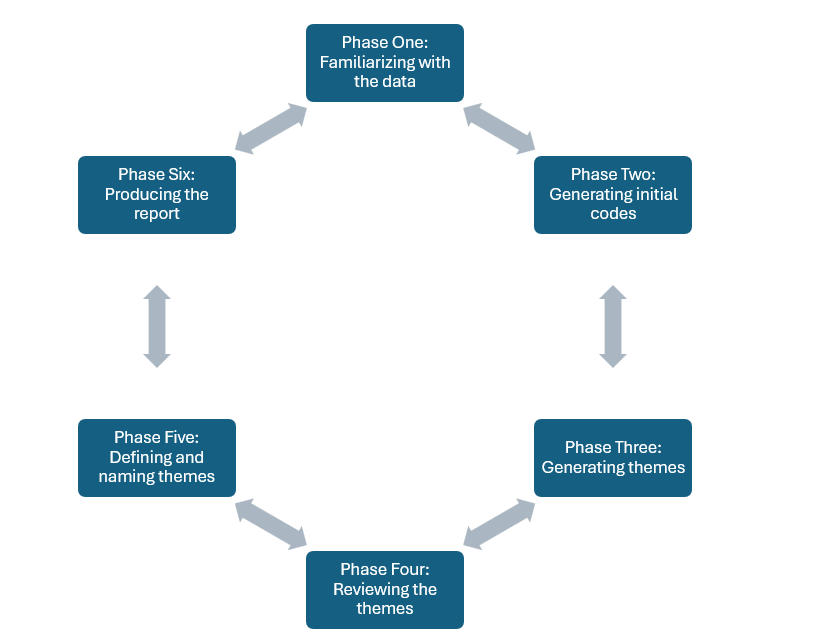
- Phase Two: Generating initial codes
- Phase Three: Generating themes
- Phase Four: Reviewing the themes
- Phase Five: Defining and naming themes
- Phase Six: Producing the report
We offer the best thematic analysis using software; specifically, NVivo, MAXQDA, Atlas.ti, and QDA Miner. Once your collected data is cleaned and formatted for analysis, we usually import it into a Computer-Assisted Qualitative Data Analysis Software such as NVivo, MAXQDA, Atlas.ti, or QDA Miner before we begin adhering to Clarke and Braun’s thematic analysis six steps. In the sections below, we discuss the thematic analysis steps used by our qualitative data analysts.
Thematic Analysis Phase One: Familiarizing with the Data
The first phase of the thematic analysis process involves reading and re-reading the data set, to gain familiarity with the collected data. In this phase, our qualitative data analysis experts read and re-read your data to gain a comprehensive understanding of the responses. When reading the qualitative researcher identifies emerging concepts and notes them on a notebook for reference in the coding phase. We understand that the first phase of the qualitative thematic analysis is essential because it promotes gaining a comprehensive overview of the data, which is important in creating a foundation for the thematic analysis.
Thematic Analysis Phase Two: Generating initial codes
Generating codes in the thematic analysis process involves identifying succinct, descriptive, or interpretive labels for participants’ responses. In this phase, our experts review the collected data to identify the recurrent and interesting concepts from participants’ responses to inform developing themes. The coding process is iterative and supports the researcher in familiarizing with the data more.
Thematic Analysis Phase Three: Generating themes
Phase three of Clarke and Braun’s thematic analysis involves combining the identified codes to generate themes. When generating the themes, the focus is to answer the research questions, while also identifying any discrepant cases in the data. Our thematic analysts ensure that the generated themes directly answer the research questions.
Thematic Analysis Phase Four: Reviewing the themes
Phase four of the thematic analysis framework by Braun and Clarke involves reviewing the themes where the qualitative researcher assesses whether the themes are supported by adequate verbatim responses. In addition, we assess whether the themes have been supported by relevant information to answer the research question(s).
Thematic Analysis Phase Five: Defining and Naming Themes
The fifth step of the thematic analysis by Braun and Clarke is defining and naming themes using participants’ verbatim responses. The themes should be defined in the context of the study, with the support of responses by participants, to promote the results’ trustworthiness.
Thematic Analysis Phase Six: Producing the Report
The final phase of Braun and Clarke’s thematic analysis process is producing the report. The process involves writing the findings, which we categorize according to the research questions and themes. Our thematic analysts ensure that the report is concise, coherent, logical, and non-repetitive. We guarantee that the write-up will contain enough extracts to answer the research questions, beyond just providing a narrative description.
Get our thematic analysis services for qualitative research to gain in-depth insight into your data. Thematic analysis by Braun and Clarke is a suitable guiding framework for analyzing data. Our qualitative data analysts are conversant in Braun and Clarke’s thematic analysis steps, which is rational enough for you to entrust us with your data. We guarantee that we will perform a thematic analysis that derives in-depth insights, underpinning in answering your research questions.
The specific services we offer include:
- Thematic analysis of the collected data (interviews, focus groups, observations, and archival data).
- Report writing, presenting the answers to your research questions in the form of themes, supported by verbatim responses.
- Discussion of the findings, in the context of existing literature and providing the implications, recommendations, and conclusions.
Contact us now and let’s discuss how you can get Braun and Clarke thematic analysis services by qualitative research data experts using NVivo or MAXQDA