
Most guides in qualitative coding provide you with two options (inductive or deductive) and ask you to pick a side. The choice is either you start from theory and code your data against it (deductive coding), or you derive the codes from transcripts (inductive coding). Conversely, there is a third option, abductive coding, which involves deriving codes from the collected interviews and supported by literature.
What is Abductive Coding?
Abductive coding is a qualitative data analysis approach in which researchers develop codes by moving back and forth between the empirical material and existing theory. Instead of choosing inductive or deductive reasoning, researchers treat unexpected observations in the data as the starting point for plausible explanation.
The goal in abductive coding is to determine the most credible account of the reasons why data look the way it does. The distinct feature of abductive coding in qualitative research is that it requires considering data and literature informing each other, instead of choosing one as the sole author.
What Does Abductive Reasoning Mean in Qualitative Research?
Abductive reasoning involves observing something, then reasoning about the most likely cause or account that would make sense of it. Abductive reasoning was fully developed by philosopher Charles Sanders Peirce.
A short abductive reasoning example is: you walk into the kitchen and find the floor wet. You did not see it happen, so you cannot deduce the cause with certainty; you have not gathered enough cases to generalize. Instead, you reason that the most plausible explanation is that the dog knocked over its water bowl again. The transition from an observation to the likeliest explanation is abduction. In research terms, the wet floor is a passage in an interview that does not behave the way your theory predicted. Abductive coding asks you to name the best available explanation for it and to keep testing that explanation against the rest of your data.
Abductive vs Inductive vs Deductive Coding
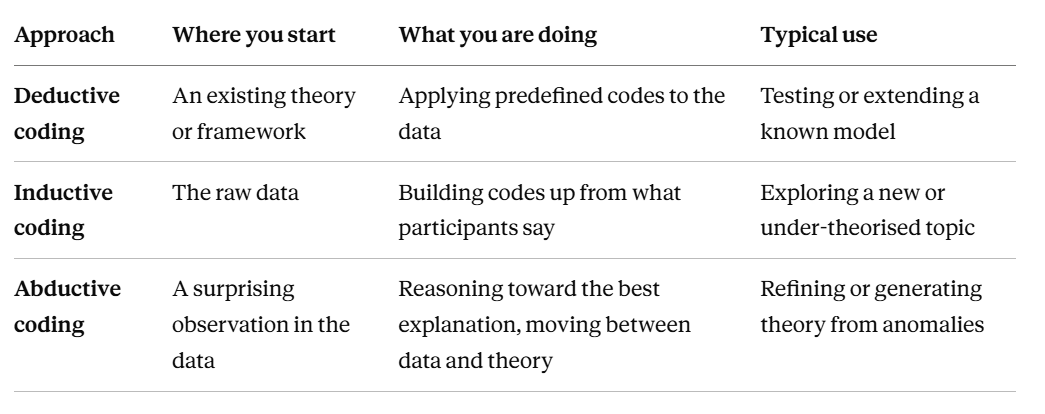
When conducting thematic analysis, abductive coding gives researchers permission to admit that you brought prior knowledge to the data, and the data changed your mind.
Abductive Thematic Analysis: How Abductive Coding Works: A Worked Example
The following qualitative coding example provides an example of how abductive coding can be applied in a study of remote workers and how they mark the end of the working day.
The first step of abductive coding is reading the transcripts to identify participants’ own words. When reading, you can identify that participants say that she “commutes” from their desk to their sofa, which is a three-meter distance.
Second is coding the verbatim response as “end-of-day routine”
Third is applying the theory, where you find literature on boundary work and transition rituals. This forms a plausible explanation that remote workers develop symbolic transitions to replace the physical ones they lost when working from the office.
Fourth is creating a code such as “manufactured transition ritual,” which you apply throughout the remaining transcripts.
Fifth, by the end, your codes will either be bottom-up or imposed. Instead, they are the best explanation that can be derived from what participants were actually doing.
Creating an Abductive Codebook
An abductive codebook should contain a short code, a respective definition, a supporting quotation that anchors the meaning, and a brief explanation of the theoretical idea the code relates to support the audit trail.
The Research Data Experts can help you with your abductive coding. Our experts leverage CAQDAS such as MAXQDA, NVivo, and Taguette to develop structured codebooks. Talk to us and let us know how we can help.