
Deductive coding in qualitative research is a top-down approach to analyzing data. The process involves a researcher deciding the codes before assessing the data, then applying the codebook to each transcript, document, or field note. The prior codes are derived from established theory, a conceptual framework, or published literature.
For instance, in a nursing study, Orem’s self-care theory is applied; the predetermined codes from the theoretical framework are: Universal self-care, developmental self-care, or health deviation self-care.
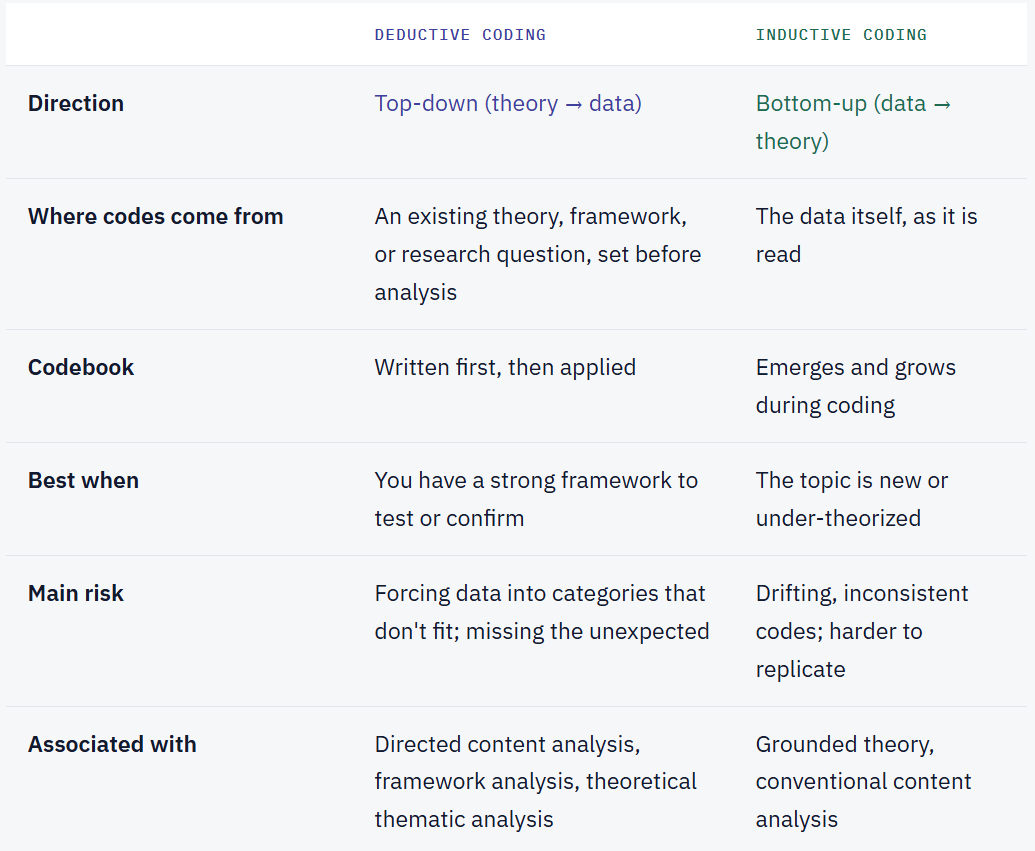
The opposite of deductive coding is inductive coding, where researchers derive codes from the collected interview transcripts. A third logic is abductive coding, where researchers begin with theoretical ideas, but remain open to emerging or unexpected patterns that emerge inductively from the text.
Deductive Coding vs. Inductive Coding in Qualitative Research
When Should Qualitative Researchers Use Deductive Coding?
Deductive coding should be applied if (a) you have a string theoretical framework, (b) you are replicating or extending prior work, (c) you have specific research questions that can be naturally mapped onto predefined codes, and (d) you have a large data set.
How to Conduct Deductive Coding
Step 1: Anchor the framework and Question: Begin by stating the theory or research questions that the codes will be derived from. This is the source you are testing and justifying every code you write.
Step 2: Draft the codebook: For each code, write a short name, definition, when to apply it, and an example. Clear boundaries are important in effectively defining the codes.
Step 3: Pilot on a subset: The process involves applying the draft codes to a few transcripts, which allows for determining whether there are any codes that overlap, never appear, or need splitting. It will be essential to revise the subset before proceeding.
Step 4: Code the full dataset: This involves tagging segments of the qualitative data sources with the respective codes. Importing the interviews, focus group discussions, or documents into NVivo or MAXQDA supports effectively coding the data.
Step 5: Analyze and interpret: Here, the focus is on identifying patterns, frequencies, and relationships to answer the research questions.
During the process, keeping an audit trail will be essential as an approach for promoting the findings’ trustworthiness.
Sample Deductive Coding Example
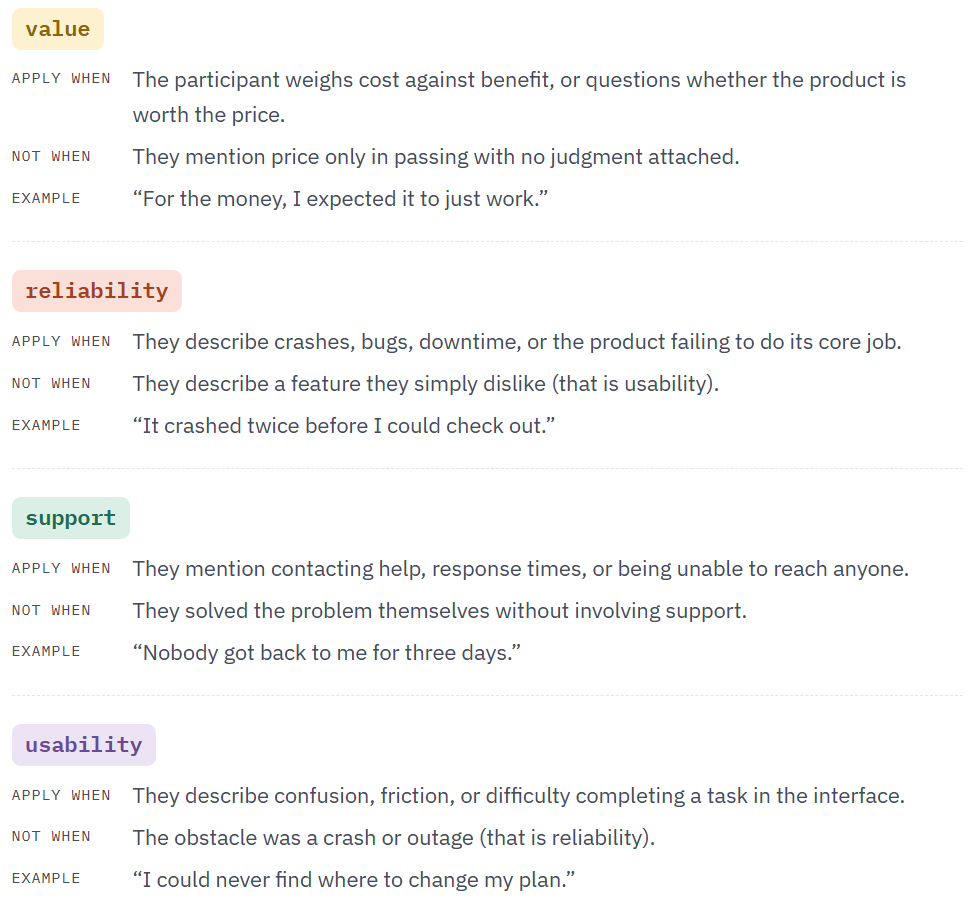
Let us assume your study is on the reasons why users abandon a subscription application. Instead of letting the themes emerge from the data, you decide upfront that the factors that matter the most are value, reliability, support, and usability. Here is a sample deductively coded codebook.
Promoting Rigor in Deductive Coding
Rigor in deductive coding in qualitative research is promoted through intercoder reliability, audit trail, triangulation, and reflexivity. Intercoder reliability is achieved when different researchers perform the coding and then use measures such as Cohen’s Kappa to make a genuine decision. Triangulation involves having different data sources, coders, or methods. Reflexivity requires researchers explicitly acknowledging how their experiences or assumptions might impact findings’ interpretation.
Need help with your deductive coding in qualitative research? Let us know how we can help.