
What is Coding in Qualitative Research?
Coding is the process of labeling segments of qualitative data (interviews, focus group discussions, observations, and document analysis) with short tags that capture their meaning. A qualitative code can be a single word or brief phrase such as fear of relapse or reliance on routine, which is attached to a sentence, clause, or a whole paragraph of an interview, focus group, open survey, or field note. The goal of qualitative coding is to make a large body of unstructured text searchable by meaning, so that it is easy to identify the coded segments together.
What is the Difference Between a Code Category and Theme in Qualitative Research
- Code: The closest label to the data (e.g. skipping meals to save money).
- Category: A group of related codes (e.g. coping strategies).
- Theme: A broader pattern of shared meaning that answers your research question (e.g. everyday adaptation to scarcity). A theme is a claim about what the data means.
Worked Example of Coding a Qualitative Interview, Line by Line
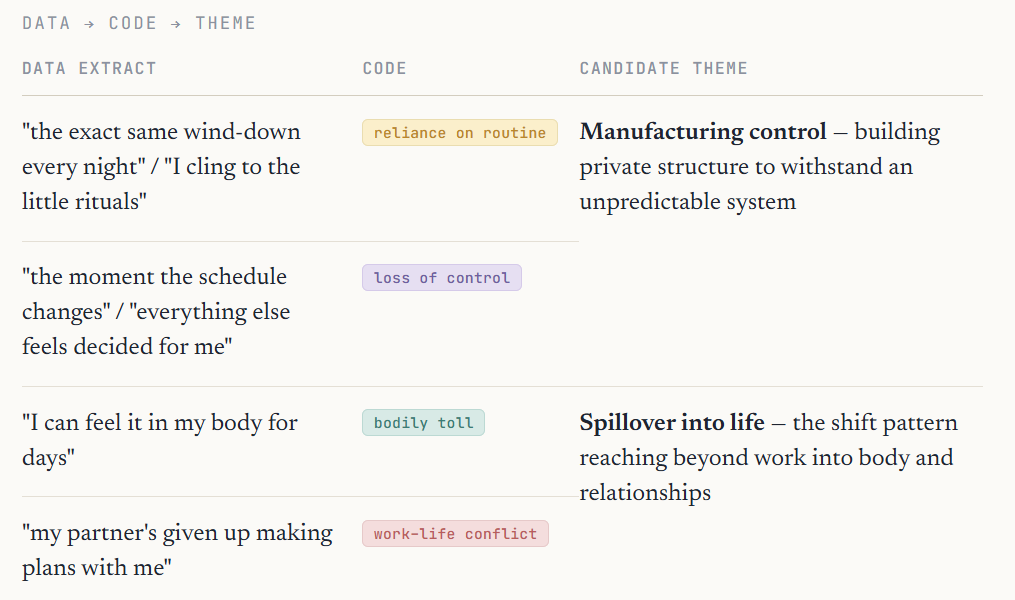
Here is a short extract from a coded interview with a shift worker, related to sleep. The qualitative coding can be done using NVivo or MAXQDA.

Notice that segments can overlap and a single stretch of talk can carry more than one code. Coding is interpretive, not clerical.
Notice too that the codes stay close to the participant’s own words. That is in vivo or descriptive or semantic coding. Later passes move to more interpretive (or latent) codes that name the underlying idea rather than the surface content.
Converting Qualitative Coded to Themes
Once every transcript is coded, you cluster the codes and ask what larger patterns they form. Here’s how the four codes above ladder up into two candidate themes:
Types of Coding in Qualitative Research
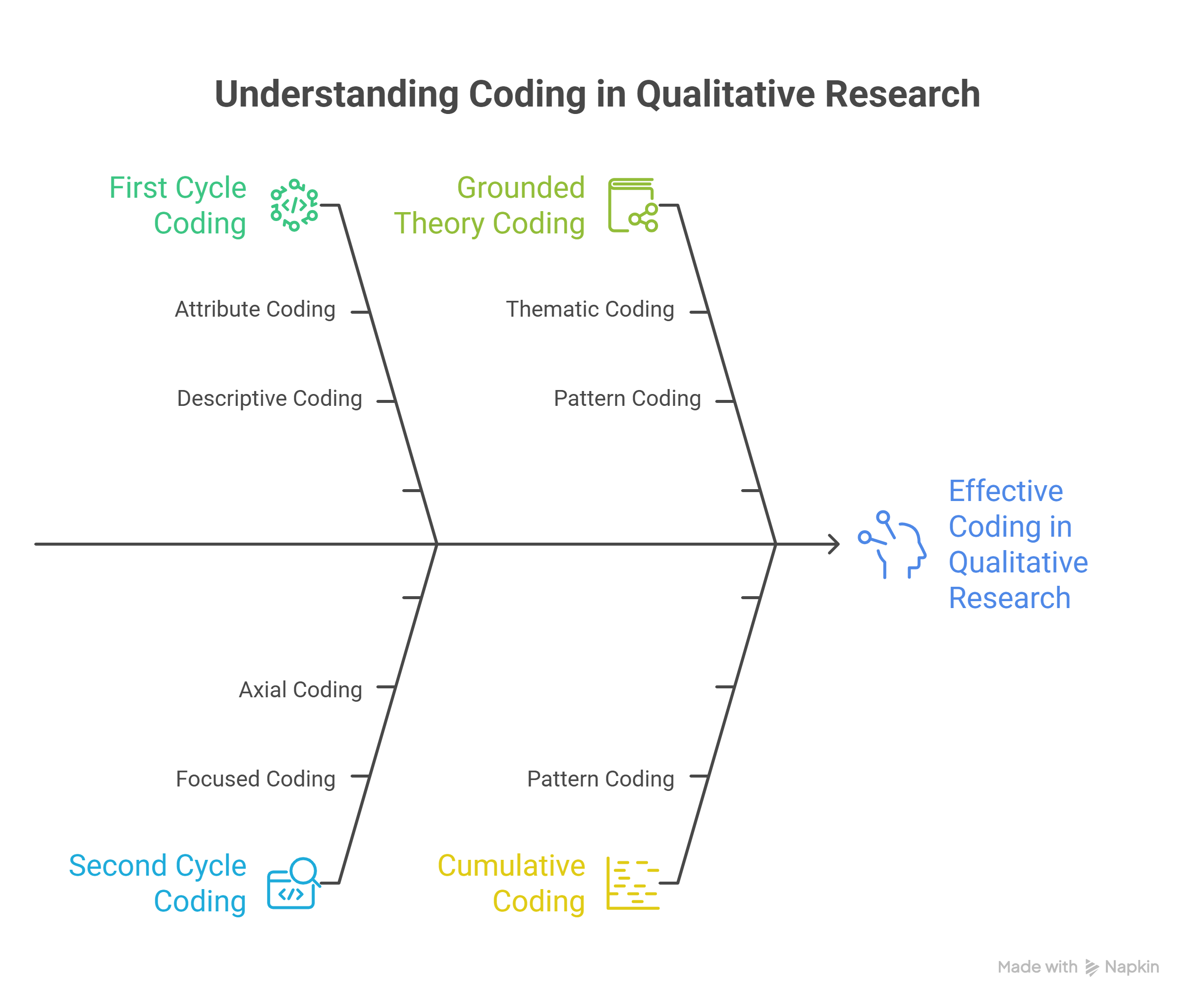
In the methods section of a qualitative paper, it is essential to answer the following questions: Where do the codes come from? And what stage or style of coding is it? There are two cycles of qualitative research coding: First and second cycles.
First Cycle Coding
There are different types of first cycle coding methods; in this case, we are going to focus on the four most common first cycle coding approaches, namely: Attribute coding, descriptive coding, in vivo coding, and initial coding.
Attribute Coding
Used in coding descriptive information such as participants’ demographic characteristics or demographics.
Descriptive Coding
Involves assigning labels (nouns) to data to summarize in a word or short phrases.
In Vivo Coding
Qualitative researchers use words or short phrases from participants’ own language in the data record as codes.
Initial Coding
Initial coding is the first major open-ended stage of a grounded theory approach to the data, which can incorporate In Vivo and Process Coding. Initial coding is applicable in all qualitative studies because it allows researchers to identify codes solely from the collected data.
Second Cycle Coding
The purpose of second cycle coding is synthesizing and putting codes into new ideas of meanings. Second cycle coding in qualitative research is categorized into two: grounded theory coding methods and cumulative coding methods.
Grounded Theory Coding Methods
Grounded theory coding methods in qualitative research include focused coding, axial coding, and thematic coding.
Focused Coding
Conducted after In Vivo, process, and/or initial coding to categorize coded data according to thematic or conceptual similarity.
Axial Coding
Used to extend analytical fork from initial coding, by focusing on describing a category’s properties and dimensions. Axial coding is used to explain how categories and subcategories relate to each other. The approach is appropriate for studies conducted using a grounded theory methodology.
Thematic Coding
Involves combining codes into themes that directly answer the research questions. There are different thematic coding procedures, such as Braun and Clarke thematic analysis.
Cumulative Coding Methods: Pattern Coding
In pattern coding, the focus is on identifying similar coded data to identify trends, which can be used in answering a research question.
Order thematic coding in qualitative research from experts who understand the process.