Search

Gioia Method Qualitative Data Analysis Services

We provide expert Gioia Method Qualitative Data Analysis Services, transforming your raw interview transcripts into a structured, publication-ready data architecture. Our analysts build your complete 1st-order concepts, 2nd-order themes, and aggregate dimensions, delivered with a data structure diagram that meets the rigorous standards required by top academic journals. Trusted by PhD scholars, doctoral researchers, and academic institutions worldwide.

What Is the Gioia Methodology?

The Gioia methodology, which was developed by organizational theorist Dennis A. Gioia, is a systematic, inductive approach to qualitative data analysis designed to meet the rigorous standards demanded by top academic journals.

Unlike traditional thematic analysis, the Gioia method builds an explicit data structure that visually demonstrates how participant language evolves into researcher-level theoretical themes and, ultimately, into overarching aggregate dimensions. This three-layer architecture makes your qualitative findings verifiable, credible, and defensible during peer review.

Originally developed for management and organizational studies, the Gioia method is now widely applied across social sciences, entrepreneurship, international business, healthcare management, and public policy, in any field where you need to inductively develop theory from qualitative data. Get our Gioia Method Qualitative Data Analysis Services to gain in-depth understanding of your data

PILLAR 1: Developing a Data Structure

Organizing raw participant concepts into a visual hierarchy of 1st-order codes, 2nd-order themes, and aggregate dimensions that trace the analytical journey with full transparency.

PILLAR 2: Developing a Grounded Theory Model

Building a dynamic model that captures relationships between emergent concepts, themes, and dimensions, illustrating how your findings constitute a novel theoretical contribution.

PILLAR 3: Presenting Findings in a Convincing Narrative

Articulating the analysis through an evidence-grounded narrative that connects participant voice to scholarly insight in a way that resonates with reviewers and readers alike.

Our Gioia Method Qualitative Data Analysis Process

Our qualitative data experts follow a rigorous, step-by-step workflow to deliver a complete, publication-ready Gioia Method Qualitative Data Analysis Services tailored to your research questions and discipline.

STEP 1: Data Intake & Research Alignment: We review your research questions, interview transcripts, and target journals to fully understand the analytical scope and discipline-specific expectations before any coding begins.

STEP 2: 1st-Order Concept Identification: Our experts systematically code your transcripts using NVivo or MAXQDA, preserving participant language to identify and label recurring raw concepts as they emerge from the data.

STEP 3: 2nd-Order Theme Development: 1st-order concepts are theoretically abstracted into higher-level 2nd-order themes using both inductive and abductive reasoning, connecting participant voice to existing scholarly discourse.

STEP 4: Aggregate Dimension Construction: Related 2nd-order themes are grouped into overarching aggregate dimensions, the core theoretical constructs that represent your study’s original contribution to knowledge.

STEP 5: Data Structure Diagram: We build the complete, publication-ready data structure figure that traces the full analytical journey from raw codes to aggregate dimensions ready for direct inclusion in your results chapter.

STEP 6: Report & Grounded Theory Model: You receive a comprehensive analysis report, the data structure diagram, the grounded theory model, and all coded data files reviewed by a senior qualitative analyst before delivery.
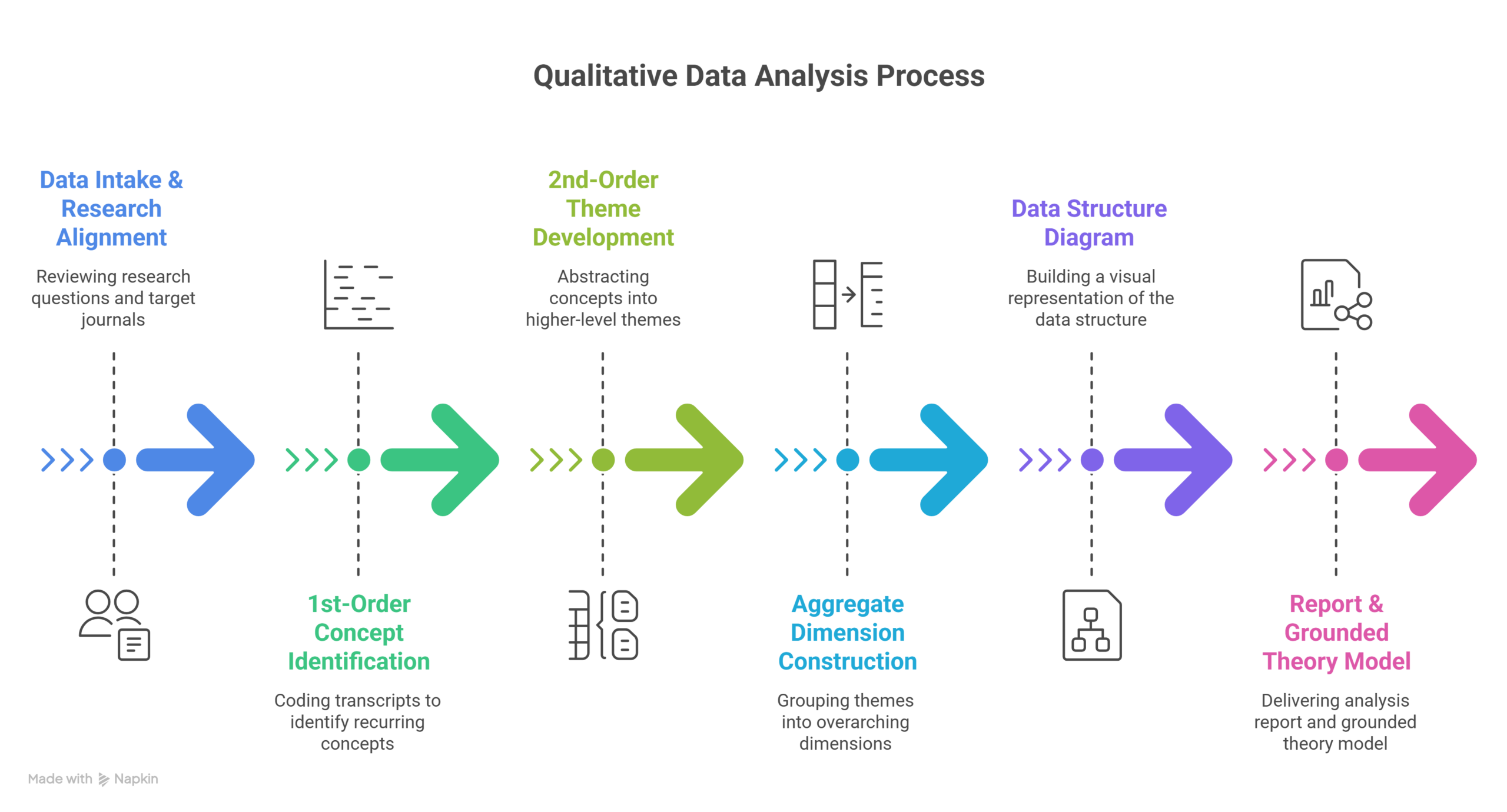
Gioia Method Qualitative Data Analysis Services: Gioia methodology data structure diagram showing 1st-order concepts, 2nd-order themes, and aggregate dimensions

Gioia Method Qualitative Data Analysis Services Use Cases

The Gioia method is ideal for any qualitative study involving semi-structured interviews where the goal is inductive theory development across a wide range of disciplines and contexts.

Why Choose our Qualitative Data Analysis Services 

Our qualitative data analysts combine deep methodological expertise with practical research experience, so your Gioia method analysis meets the highest standards of academic rigor and credibility.

Methodology Specialists: Our analysts are trained in the Gioia methodology’s philosophical underpinnings, interpretivism, abductive reasoning, and grounded theory, not just its procedural steps.

CAQDAS Expert Coders: We use NVivo, MAXQDA, and QDAMiner to systematically code, categorize, and organize your data, ensuring a traceable, auditable analytical trail.

Publication-Ready Output: Every data structure diagram we produce is formatted to the standard expected by AMJ, JIBS, and other leading journals that regularly publish Gioia methodology studies.

Confidential & Secure: Your research data is handled with strict confidentiality.

Rapid Turnaround: We understand dissertation deadlines. Our streamlined workflow delivers rigorous Gioia analysis within agreed timelines, with regular progress updates throughout.

24/7 Dedicated Support: Our customer experience team is available around the clock. Your assigned analyst is reachable for revisions, clarifications, and consultation at every stage.

Gioia Method FAQ

What is the Gioia method in qualitative research?

A: The Gioia methodology is a systematic approach to inductive qualitative data analysis developed by organizational theorist Dennis A. Gioia. It provides a structured, transparent way to move from raw interview data to grounded theory through three analytical layers: 1st-order concepts (verbatim participant language), 2nd-order themes (theoretical abstractions by the researcher), and aggregate dimensions (overarching theoretical constructs). The entire process is visualized in a data structure diagram that demonstrates the rigor of the analytical journey.

What is the difference between 1st-order and 2nd-order concepts in the Gioia method?

A: 1st-order concepts are grounded in the actual language used by your research participants; they reflect how informants themselves describe their experiences, with minimal researcher interpretation. 2nd-order themes represent the researcher’s theoretical interpretation of those raw concepts, abstracting them into scholarly constructs that connect to existing theory. This dual-order structure gives the Gioia methodology its distinctive balance between practical relevance (participant voice) and theoretical rigor (scholarly abstraction).

Can you help me apply the Gioia method to my dissertation?

Absolutely. We work extensively with doctoral students applying the Gioia method in their dissertations and theses. Our analysts code your interview transcripts, construct the full 1st-order → 2nd-order → aggregate dimension hierarchy, develop the data structure diagram and grounded theory model, and provide a detailed report explaining the analytical process, everything you need for a rigorous, defensible qualitative findings chapter.

error: Content is protected !!