Step 1: Build a PICOT Question That Can Actually Be Answered
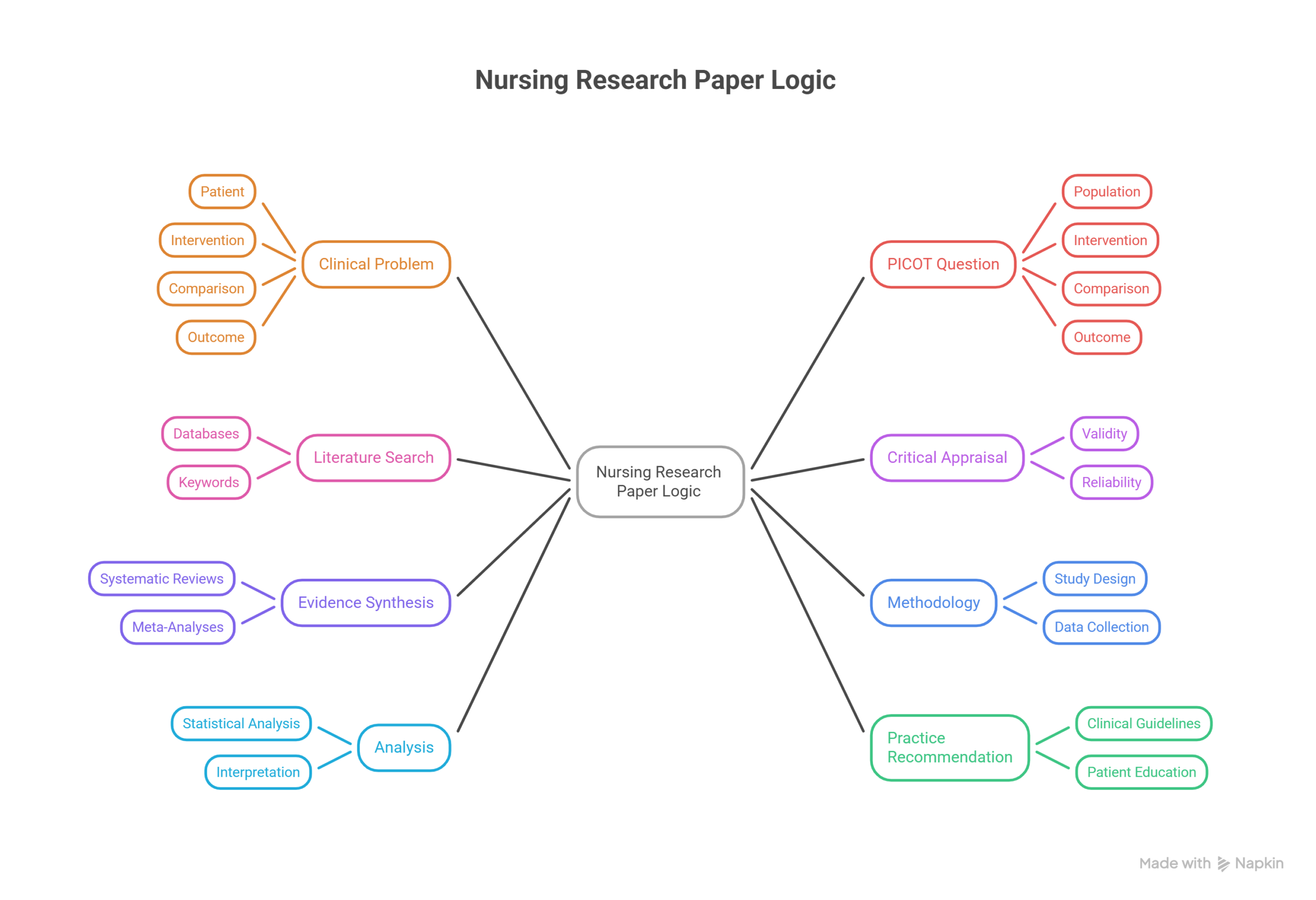
The PICOT question is the foundation of nursing research paper. Get it wrong and every later section wobbles. PICOT stands for Population, Intervention (sometimes called variable of interest), Comparison, Outcome, and Time. In psychiatric mental health nursing, the “intervention” is frequently a nursing-led behavioral or structural change rather than a medication, and that’s completely legitimate.
A useful template: In [population] (P), does [intervention] (I) compared with [comparison] (C) affect [outcome] (O) over [time] (T)?
Worked PICOT Questions for PMHN examples
Here are three PICOT questions at increasing levels of specificity, each in a distinct psychiatric domain:
Suicide prevention (screening): In adult patients admitted to an inpatient psychiatric unit (P), does structured suicide-risk screening using a validated tool (I) compared with routine clinical assessment (C) reduce the rate of in-unit suicide attempts (O) over six months (T)?
Restraint reduction (safety): In adults on an acute psychiatric inpatient unit (P), does nurse-led de-escalation training (I) compared with standard restraint practice (C) reduce the use of physical restraint (O) over six months (T)?
Readmission (continuity of care): In adults with schizophrenia discharged to community settings (P), does nurse-led medication-adherence support using motivational interviewing (I) compared with standard discharge planning (C) reduce 90-day psychiatric readmission (O) (T)?
Step 2: Run a Literature Search
A literature review is not “some articles I found on Google.” It’s a deliberate, documented search of the scholarly record that answers your question. Health sciences librarians at institutions like Johns Hopkins teach a repeatable eight-step process; here’s the practical core of it.
Turn your PICOT into search terms.
Your P, I, C, and O, especially the nouns and adjectives, become your keywords. For the restraint example above:
Concept 1 (population/setting): psychiatric inpatient, acute mental health unit
Concept 2 (intervention): de-escalation, verbal de-escalation, staff training
Concept 3 (outcome): physical restraint, seclusion, restraint reduction
Then build a search string using Boolean logic: AND between different concepts to narrow, OR between synonyms to broaden.
(“psychiatric inpatient” OR “acute mental health unit”) AND (de-escalation OR “verbal de-escalation”) AND (restraint OR seclusion)
Use quotation marks around phrases, and use MeSH (Medical Subject Headings) terms in databases that support them to catch articles that use different wording for the same concept.
Search the right databases.
For nursing, prioritize CINAHL, PubMed/MEDLINE, PsycINFO (essential for mental health topics), and the Cochrane Library for systematic reviews. Google Scholar is fine for a first pass but shouldn’t be your only source.
Two techniques that find what keyword searches miss
Seed article + citation chasing: Start from one strong, on-topic article. Then use a citation database to find newer papers that cited it; those are often the most current work on your exact question.
Snowballing: Mine the reference list of your best articles for older foundational studies. This also surfaces the highly cited authors who are the recognized experts in your niche.
Document your search as you go: databases searched, terms used, date ranges, and how many results you screened. Many rubrics require this, and it’s what makes your review reproducible rather than anecdotal. Our nursing research paper experts understand how to conduct comprehensive literature reviews.
Step 3: Appraise the Evidence
Finding articles is the easy part. Judging them is where nursing research papers earn their grade. Two dimensions matter: the level of evidence and the quality of each study.
Levels of evidence
Evidence sits in a rough hierarchy. Systematic reviews and meta-analyses of randomized controlled trials sit near the top; expert opinion sits near the bottom. Tools like the Johns Hopkins Nursing Evidence-Based Practice (JHNEBP) model give you a structured way to rate both level and quality. Note a common assignment rule: systematic reviews, literature reviews, and meta-analyses are strong evidence but are not primary research, so if your assignment asks for primary studies, don’t count them toward that requirement.
Many nursing assignments ask for a mix (for example, two quantitative and two qualitative primary studies). Quantitative studies measure and count (restraint rates, readmission percentages, symptom scores) using controlled designs and statistics. Qualitative studies explore experience and meaning through interviews and narrative data, for instance how psychiatric nurses describe the emotional and ethical weight of using seclusion.
The most common beginner mistake is a “book report” review: one paragraph per article, marching down the list. Instead, group findings by theme (e.g., effectiveness of de-escalation, barriers to staff adoption, measurement of restraint outcomes) and synthesize across studies within each theme. This is what a literature review actually is: a structured argument about the state of the evidence, with the gaps made visible. Get expertise from our nursing research paper experts
Step 4: Write the Methodology Section
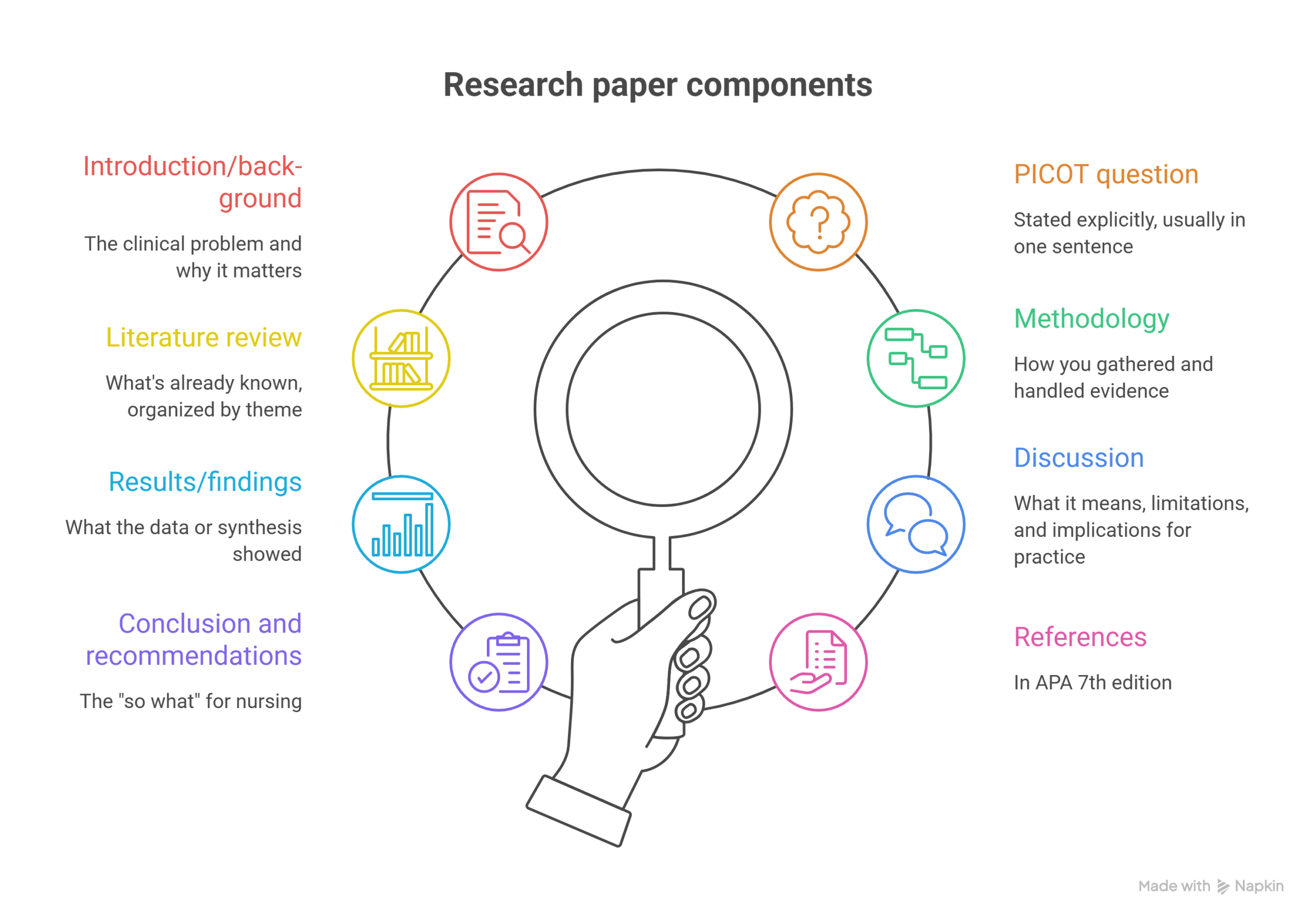
The methodology explains how the knowledge was produced so a reader could evaluate or replicate it. For a primary study you’re conducting, describe your own methods. For an evidence-based practice review, describe how you searched, selected, and appraised the literature. Either way, cover these elements.
Design. Name and justify it: systematic literature review, quality-improvement project, quasi-experimental pre/post design, qualitative descriptive study, and so on. Say why this design fits your question.
Population and sample. Who or what is included, and how were they selected? State inclusion and exclusion criteria explicitly (e.g., “peer-reviewed primary studies, 2019–2025, adult inpatient psychiatric populations, English language”).
Setting. Where does this take place, a 24-bed acute unit or a community mental health clinic?
Intervention/procedure. Describe exactly what was done and in what sequence. Precision here is what lets someone reproduce your work.
Measurement. What outcomes did you track and with what instruments? Name validated tools where you can (for example, a recognized suicide-risk screening instrument), and note their reliability and validity.
Data collection. How, when, and by whom were data gathered?
Ethics. This is not optional in nursing research. Address IRB (Institutional Review Board) approval, informed consent, confidentiality, and, especially in psychiatric populations, the extra safeguards owed to a potentially vulnerable group.
PMHN caution: Vulnerability and capacity to consent are live ethical issues in psychiatric research. A methodology section that glosses over consent and IRB oversight will lose credibility fast. Name your safeguards specifically.
Step 5: Analyze the Data and Present the Results
Quantitative analysis. Start with descriptive statistics (means, frequencies, percentages) to describe your sample and outcomes, then use inferential statistics (t-tests, chi-square, regression, and so on) to test whether differences are likely real rather than chance. Report effect sizes and confidence intervals where you can, not just p-values; a statistically significant change of trivial magnitude isn’t clinically meaningful.
Worked illustration: For the restraint-reduction question, you might report that physical-restraint episodes fell from 12.4 to 7.1 per 1,000 patient-days after de-escalation training, and use a chi-square or interrupted time-series analysis to test whether that drop is statistically significant.
Qualitative analysis. Here you’re identifying patterns in narrative data, most commonly through thematic analysis: coding transcripts, grouping codes into themes, and reporting those themes with representative (de-identified) quotes. Rigor comes from transparency about how you coded and from techniques like member checking.
Presenting results. Keep the results section factual (what you found) and save interpretation for the discussion. Use tables and figures for anything a reader would struggle to hold in their head as prose (a literature evaluation table is a classic nursing example). Every table and figure needs a number, a title, and an in-text reference.
Step 6: Discussion, Recommendations, and Conclusion
The discussion answers “so what?” Interpret your findings in light of the literature: Do they agree with prior work? Contradict it? Fill a gap you identified earlier? Then be honest about limitations (small sample, single site, short follow-up), because naming them is a sign of rigor, not weakness.
Close with practice recommendations that are specific and actionable. “More research is needed” is weak on its own; “acute inpatient units should adopt structured de-escalation training and track restraint rates monthly, with re-training every six months” is a recommendation a nurse leader could act on. Tie it back to the level of evidence you found so readers know how much confidence to place in it.
Formatting, APA, and Academic Integrity by Nursing Research Paper Experts
APA 7th edition is the standard for nursing research papers. Pay attention to the title page, running considerations, heading levels, in-text citations (author, year), and a properly formatted reference list. Consistency matters; graders notice.