Reflexive Analysis in Qualitative Research
Reflexive analysis in qualitative research: a guide to understanding, applying, and commissioning professional reflexive thematic analysis for your dissertation, thesis, or research project.
What Is Reflexive Analysis in Qualitative Research?
Reflexive analysis in qualitative research is the systematic, ongoing practice of critically examining how the researcher’s own positionality, including their background, values, biases, and theoretical assumptions, shapes every stage of the research process, from the design of the research question through to the reporting of findings.
In any qualitative study, the researcher is not a neutral observer. They bring lived experiences, disciplinary training, cultural context, and inherent assumptions to every interpretive decision they make. Reflexive analysis in qualitative research makes this influence explicit rather than invisible, treating it as a methodological asset rather than a source of error to be minimized.
Unlike purely positivist approaches that aim for researcher neutrality, reflexive qualitative analysis embraces subjectivity but does so with rigorous transparency. The goal is not to eliminate the researcher’s influence (which is impossible) but to account for it clearly, so that readers can evaluate the credibility and trustworthiness of the findings.
Reflexive Analysis vs. General Thematic Analysis
While all forms of thematic analysis involve identifying patterns in qualitative data, reflexive thematic analysis, as developed by Braun and Clarke (2006; updated 2019–2022), goes further by insisting that themes are actively constructed by the researcher rather than passively “emerging” from the data. This constructivist stance has important implications for how the analysis is documented, reported, and justified.
Why Reflexivity Matters in Qualitative Research
Reflexivity is not a methodological add-on; it is a foundational requirement of rigorous qualitative inquiry. Without it, qualitative findings risk reflecting the researcher’s unexamined assumptions more than the participants’ actual experiences or perspectives.
For doctoral researchers and academic scholars, demonstrating reflexivity is increasingly a criterion assessed in thesis viva examinations and peer-reviewed journal submissions. Examiners and reviewers look for evidence that the researcher has actively reflected on their positionality and its effects on the research, not simply included a brief paragraph about bias in a limitations section.
Types of Reflexivity in Qualitative Research
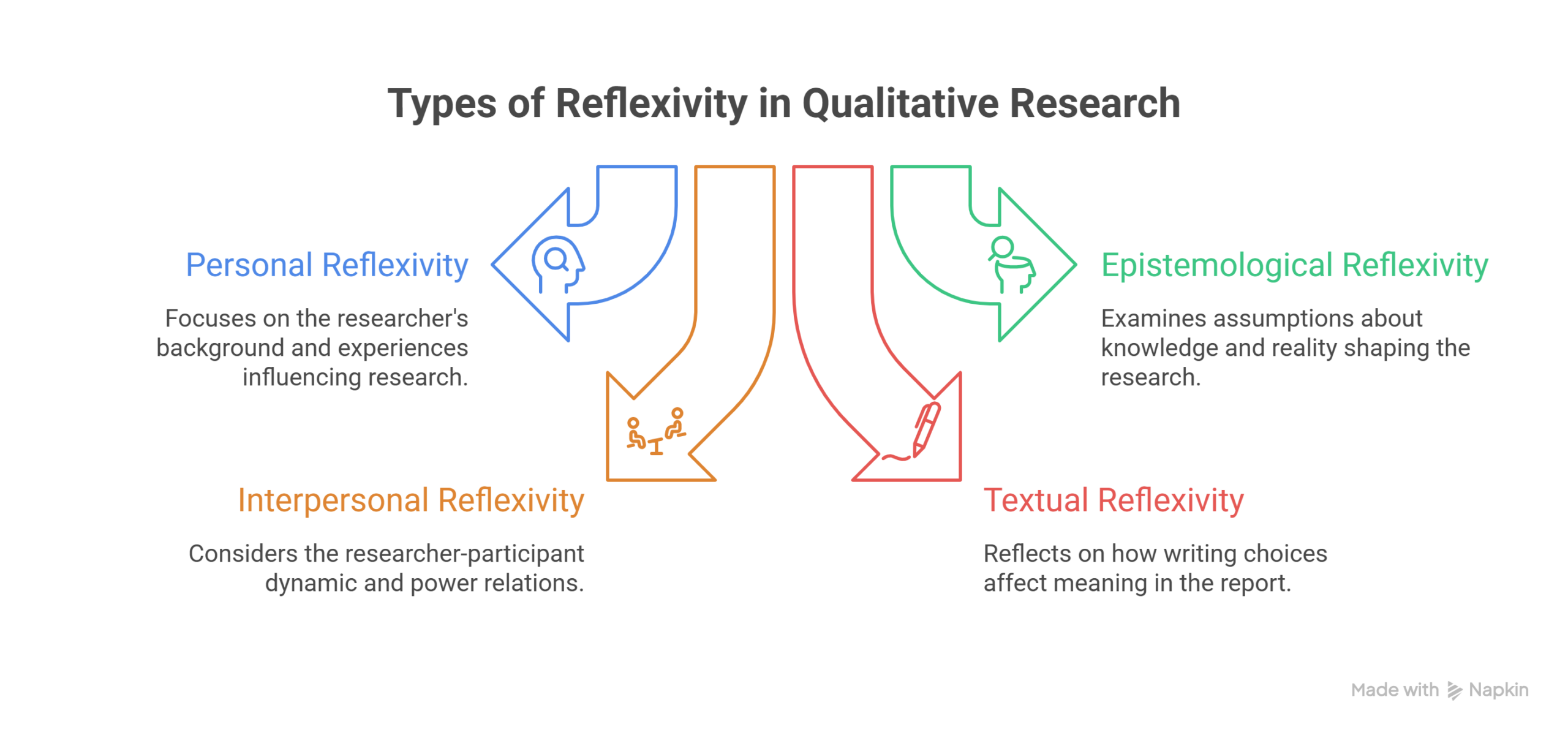
Researchers and methodologists distinguish between several related but distinct forms of reflexivity. Understanding these distinctions enables a more sophisticated and complete reflexive practice.
Personal Reflexivity in Qualitative Research
Examine how the researcher’s personal history, cultural background, identity, and lived experiences influence their research decisions, interpretations, and the relationships they form with participants.
Epistemological Reflexivity in Qualitative Research
Critically interrogates the underlying assumptions about knowledge and reality that shape the research design, methodology, data collection instruments, and analytical framework used in the study.
Interpersonal Reflexivity in Qualitative Research
Considers how the dynamic between researcher and participants, including power relations, rapport, and insider/outsider positioning, influences what data are shared, how they are shared, and how they are interpreted.
Textual Reflexivity in Qualitative Research
Reflects on how the act of writing itself, the choices of language, narrative structure, voice, and representation, shape and potentially distort the meaning communicated in the final research report.
Braun & Clarke’s Six Phases of Reflexive Thematic Analysis
The most widely adopted framework for reflexive analysis in qualitative research is Virginia Braun and Victoria Clarke’s Reflexive Thematic Analysis RTA. Originally published in 2006 and substantially refined through 2019–2022, their six-phase process provides a structured yet flexible approach to constructing themes from qualitative data while maintaining ongoing reflexive engagement throughout.
A key feature that distinguishes reflexive thematic analysis from other coding frameworks is its insistence on reflexive memos written as journal entries that document the researcher’s analytical decisions, emerging interpretations, and evolving positionality at each phase. These memos form a critical part of the audit trail and demonstrate methodological rigor to examiners and reviewers.
Software for Reflexive Thematic Analysis
Computer-Assisted Qualitative Data Analysis Software (CAQDAS) does not conduct reflexive analysis, and interpretive work always belongs to the researcher. However, the right software significantly enhances the organization, documentation, and transparency of the reflexive process.
NVivo is suitable for robust coding, node hierarchies, reflexive memo integration, and mixed-methods support.
MAXQDA is suitable for thematic maps, MAXMaps, color-coded segments, and smooth reflexive memo workflow
Our qualitative analysts at The Research Data Experts are proficient in all four platforms. We select the appropriate software based on your dataset size, research design, and disciplinary requirements, ensuring your reflexive thematic analysis is conducted with the most suitable tools for your specific project.
Researcher Positionality & the Reflexive Statement
A positionality statement is a structured declaration that describes the researcher’s social location, theoretical orientation, and relevant personal experiences, and explicitly addresses how these might influence the research. It is a cornerstone of reflexive practice and is now routinely required by ethics boards, dissertation committees, and academic journals.
What a Strong Positionality Statement Includes
- Social identities relevant to the research topic (e.g., gender, ethnicity, professional role, lived experience)
- Theoretical and epistemological stance (e.g., constructivism, critical realism, interpretivism)
- Prior knowledge or assumptions about the phenomenon being studied
- Insider/outsider status in relation to the research community or participants
- Strategies for managing bias (e.g., bracketing, member checking, peer debriefing)
- How positionality shaped analytical decisions at key points in the research
- Reflexivity should not be confined to a standalone positionality section. A fully reflexive approach embeds ongoing reflection throughout the methodology chapter, the findings, and the discussion, demonstrating a continuous rather than one-time engagement with the researcher’s role in knowledge construction.
What is the difference between reflexivity and positionality?
Positionality refers to the researcher’s social and theoretical location, who they are, and where they stand in relation to the research. Reflexivity is the active, ongoing process of critically examining how that positionality influences the research at every stage. Positionality is a statement; reflexivity is a sustained practice.
Need Expert Help with Your Reflexive Thematic Analysis?
Our qualitative analysts will conduct your reflexive thematic analysis with full methodological rigor from coding through to write-up. Get in-depth, reflexive analysis in qualitative research.
