
We understand what MAXQDA is used for in qualitative research and how to write data analysis results. Let’s begin by introducing MAXQDA as a data analysis software for qualitative research. MAXQDA is a computer-assisted qualitative data analysis software, which is regarded as one of the best in the market. The attributes that make MAXQDA one of the best CAQDAS in the market are its friendly user interface that allows organizing, analyzing, visualizing, and presenting data and the platform allows researchers to leverage AI in qualitative data analysis. As such, our qualitative research experts use MAXQDA for qualitative analysis. MAXQDA can be used in interviews, groups, observations, or document analysis
MAXQDA Qualitative Data Analysis Example
Now, let us have a look at how to perform a thematic analysis of qualitative data using MAXQDA. We will provide a step-by-step guide to show how our research data experts perform the process. The MAXQDA thematic analysis sample process is to reassure you that when you order our qualitative data analysis services, you will get expert help with your qualitative data. According to Braun and Clarke, thematic analysis is a systematic approach to identifying, organizing, and deriving insights from qualitative data, which can be presented in codes, categories, themes, and subthemes. We will use Braun and Clarke’s six-step thematic analysis process as the guide to provide a MAXQDA qualitative data analysis sample process.
Defining Thematic Analysis
Thematic analysis according to Braun and Clarke is a method for identifying, assessing, and reporting patterns/themes that are present in the collected interviews, focus groups, observations, or document analysis.
Below is a graphical representation of Braun and Clarke’s thematic analysis 6 steps:

The MAXQDA thematic analysis sample is based on a research project on participants’ lived experiences based on their culture. In the study, our research experts applied a phenomenological study design. Data were collected using semi-structured interview questions. In the following sections, we discuss how the six-phase thematic analysis can be used in conjunction with MAXQDA to facilitate data management and analysis.
Braun and Clarke Thematic Analysis Step 1: Familiarize Yourself with the Data
After you are done with data collection, the next stage is preparing your collected data to be analyzed. The process can involve transcription and uniformly formatting the transcripts to make the data analysis process seamless. The are numerous AI solutions that can perform transcription such as Otter.AI. Zoom too has a transcription feature. If you need any assistance preparing your data for MAXQDA analysis, our research experts can help. Once done with data preparation, our qualitative research experts import the data into MAXQDA.
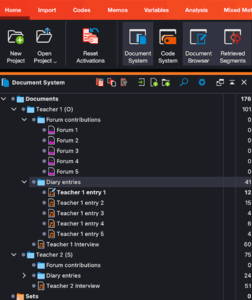
When all data are imported, our research data experts begin reading the data to gain an understanding of participants’ responses. When importing the data, we group it according to the data sources, as shown in the figure below. In the next sections, we provide a discussion on the MAXQDA introduction and our professional MAXQDA qualitative data analysis services.
Reading and re-reading the data is a time-consuming process, but it is essential because it provides a foundation for understanding the collected data. For instance, when reading the four transcripts collected in sample research, our research data experts made brief notes about any analytic ideas and insights that were recurrent or interesting. The process requires immersion into the data, to gain allow in making sense of the collected responses.
Braun and Clarke Thematic Analysis Step 2: Generate Initial Codes
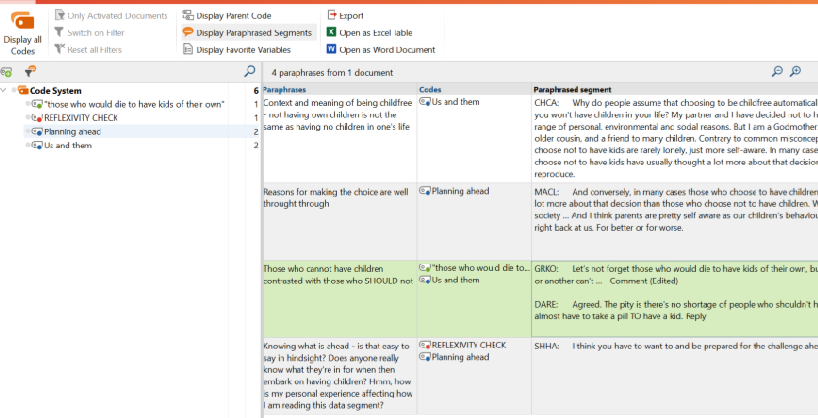
In this step of using MAXQDA in thematic analysis, the focus is on identifying codes, which provide the foundation for the themes and sub-themes (see the following image). Codes are words or phrases that represent segments of data. Generating initial codes can be done in first and second-cycle coding. First-cycle coding can be into attribute coding, in vivo coding, and initial coding. Second-cycle coding can be pattern coding. In the sample project, our researchers performed inductive coding, which involved in vivo coding, and initial coding.
Braun and Clarke Thematic Analysis Step 3: Search for Themes
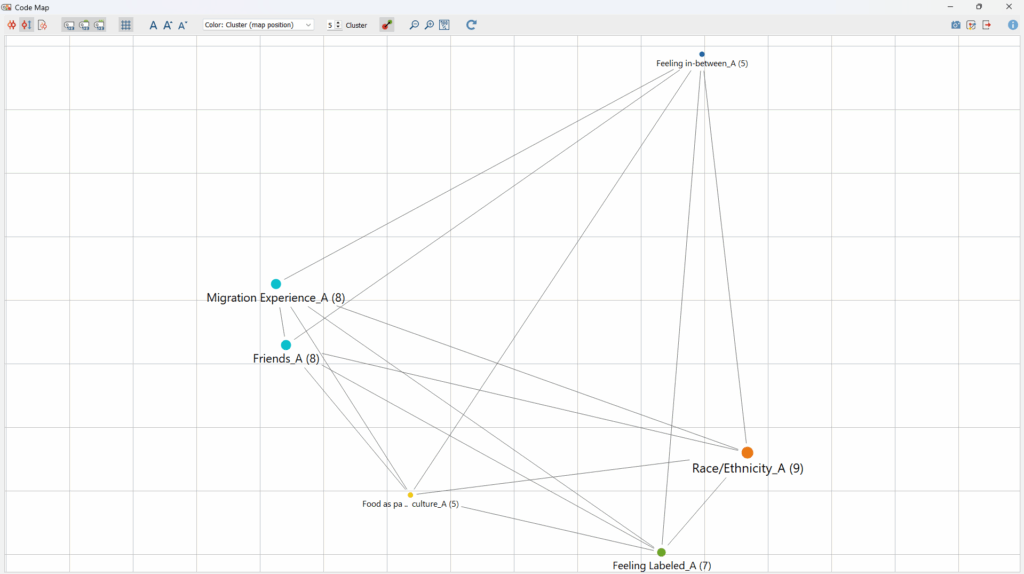
Searching for themes involves combining codes to identify the patterns or recurrent concepts that can be used in answering the research question. In the research sample, the use of thematic analysis resulted in identifying themes on race/ethnicity, feeling in-between, food as part of culture, migration experience, friends, and feeling labeled (see the image below). Here, features such as MAXQDA word cloud, MAXQDA word frequency, and MAXQDA code maps were used to facilitate discovering the patterns. For instance, the use of code maps as shown below is useful in searching for themes from the identified codes.
Braun and Clarke Thematic Analysis Step 4: Review Potential Themes
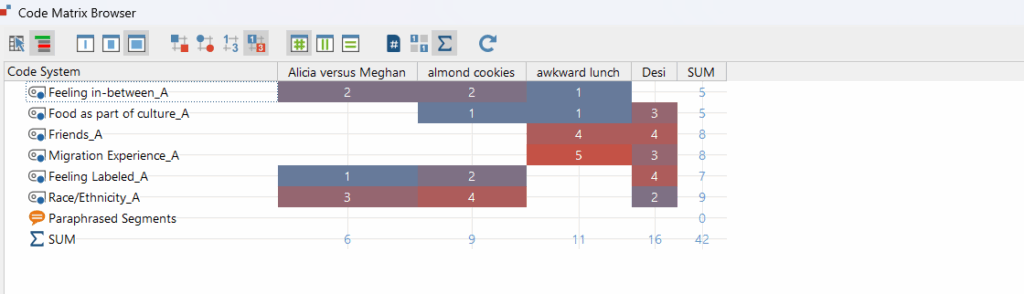
Reviewing the themes involves assessing whether the identified patterns answer the research question, are supported by verbatim responses, and are adequately overreaching. The use of MAXQDA’s code relation browser as shown below allows for identifying the frequency that a code appears in a document. Reviewing the themes assists in determining whether the identified patterns can directly answer the research question(s). For example, in sample thematic analysis, the research questions were: What are immigrants’ experiences in the United States? The themes identified are: Race/ethnicity, feeling in-between, food as part of culture, migration experience, friends, and feeling labeled.
Braun and Clarke Thematic Analysis Step 5: Define and Name Themes
After the MAXQDA qualitative analysis, the fifth step is defining and naming themes using participants’ verbatim responses. Our research data experts also derive the themes in the context of your research, study, thesis, project, or dissertation.
Braun and Clarke Thematic Analysis Step 6: Produce the Report
Producing the report involves creating a write-up that is consistent with your needs. If you did a qualitative study for academic purposes, we will use your institution’s rubric and template to guide you in creating the findings, interpretation, discussion, recommendations, implications, and conclusions sections. In the case the report is for commercial purposes, we will discuss the output report you need, ensuring we create one that serves your readers. Our MAXQDA qualitative data analysis services are tailored to you needs.
During order delivery, we will provide you with the MAXQDA Output along with the write-up of the research results. Get our MAXQDA help, we aim to derive in-depth insight into your data. We are the data analysis in qualitative research experts to go to for quality thematic analysis using MAXQDA in research.